O que é gerenciamento de projetos?
O gerenciamento de projetos (PM) refere-se à maneira como você organiza, supervisiona e conclui seu projeto e entrega valor. O PM de sucesso requer conhecimentos, habilidades, ferramentas e técnicas específicas para executar o projeto de forma eficaz dentro de determinados parâmetros, como cronograma e orçamento.
Embora o gerenciamento de projetos compartilhe muitas qualidades com as seguintes práticas, é importante entender as diferenças entre elas:
- Gerenciamento de tarefas: supervisiona a conclusão de tarefas individuais, em vez de gerenciar como as tarefas se encaixam.
- Coordenação do projeto: refere-se ao gerenciamento diário de tarefas relacionadas e a qualquer organização e comunicação necessárias envolvidas na entrega do projeto.
- Gerenciamento de processos: embora um projeto tenha um ponto final definido, um processo está em andamento e requer gerenciamento e otimização contínuos.
- Gerenciamento de programas: refere-se ao gerenciamento de vários projetos que compõem um programa e conduzem em direção a objetivos estratégicos. Pode incluir o gerenciamento de dependências entre projetos, alocação de recursos e priorização de esforços.
Setores de todos os tipos e portes dependem do gerenciamento de projetos para entregar projetos bem-sucedidos. Da mesma forma, todos os departamentos de uma organização podem se beneficiar do uso de um método de PM formalizado para se manterem organizados, colaborarem de forma mais eficiente e aumentarem a eficácia.
Para saber mais sobre metodologias específicas de PM, leia o Capítulo 3. Para saber mais sobre como o gerenciamento de projetos beneficia determinados setores e departamentos, leia o Capítulo 7.


O que é um projeto?
Um projeto é uma série de tarefas que devem ser concluídas para alcançar um objetivo predefinido. Organizações de todos os tipos e portes realizam projetos que variam de complexidade, prazo e recursos.
Um projeto é diferente de um processo, que é uma série de etapas que produzem um determinado resultado, geralmente de forma repetitiva e contínua.
Por outro lado, um projeto tem as quatro características a seguir:
- Cria uma produção nova e tangível: o principal objetivo de um projeto é criar algo novo, enquanto um processo serve para manter uma função ou serviço.
- O prazo é limitado: um projeto sempre tem uma data de início e término predeterminada.
- Existe fora das rotinas comerciais normais: um projeto é uma atividade distinta que ocorre além das operações de negócios diárias.
- Tem limites: um projeto é limitado por vários fatores, como tempo, custo, recursos e produtos. Saiba mais sobre a tripla restrição do gerenciamento de projetos a seguir.
Por que o gerenciamento de projetos é importante?
O gerenciamento de projetos é fundamental para concluir projetos dentro do prazo, dentro do orçamento e com a máxima eficiência. O PM eficaz também o ajuda a gerenciar melhor a equipe do projeto e outros recursos essenciais.
Mas a importância do PM vai além de simplesmente executar um projeto. O gerenciamento de projetos eficaz ajuda toda a organização a agregar mais valor, agilizando processos, melhorando a colaboração e reduzindo distrações que podem levar a perda de tempo, dinheiro e recursos.
A teoria da tripla restrição
No gerenciamento de projetos, a teoria da tripla restrição afirma que três limitações críticas – escopo, tempo e custo – afetam a capacidade de uma equipe de concluir um projeto. Os gerentes de projetos precisam manter o controle sobre esses três fatores para executar com sucesso.
As três restrições são definidas da seguinte forma:
- Escopo: todas as tarefas e processos necessários para cumprir os objetivos do projeto.
- Tempo: o cronograma definido para executar o projeto.
- Custo: quanto dinheiro o projeto custará para realizar.
A teoria da tripla restrição às vezes também é chamada de Triângulo de ferro ou Triângulo do gerenciamento de projetos. Essa estrutura é importante para o sucesso do projeto porque atua como uma barreira contra o crescimento do escopo.
O trabalho do gerente de projetos é equilibrar as três limitações, aumentando ou diminuindo custos, ajustando o cronograma ou eliminando ou adicionando produtos, a fim de entregar o projeto. Lembre-se que as três restrições afetam umas às outras, por isso, é fundamental pensar no efeito de qualquer escolha.
Dito isso, a maioria das equipes acha a tripla restrição tripla, pois permite ao gerente de projeto a fazer mudanças informadas com base em circunstâncias imprevistas.
Essential Project Management Skills
Essential project management skills include organization, communication, leadership, transparency, problem-solving, and stakeholder management. Strong project managers can handle large amounts of information, build trust with their teams, communicate clearly with stakeholders, and adapt quickly when challenges arise.
Here are a few essential skills for project management, as well as expert tips for early-career project managers:
Communication
Yad Senapathy says that the most important skill for a project manager is mastering the 5W+H of project management: who is the audience, what is the message, why is it being delivered, when should it be communicated, where should it appear, and how should it be presented?
Knowing these factors, he says, allows PMs to tailor messages effectively across channels, whether it’s in person or through synchronous or asynchronous communication. PMs also “need to stay in sync with the organization’s communication culture while recognizing that they are often a change agent within that ecosystem,” Senapathy says.
Tip → “Practice tailoring the same message for different audiences,” Senapathy recommends. Executives need high-level summaries, team members need task specifics, sponsors need risk updates, and clients should be briefed on progress and benefits.
Stakeholder Engagement
Stakeholder engagement involves keeping everyone invested in the project informed. “It is not enough to simply share information,” says Senapathy. “A project manager must know how to get the right people meaningfully engaged.”
Tip→ Assess stakeholders early and continue to do so throughout the project to focus energy where it matters most. For example, you may have to give more detailed or frequent business-impact updates to high-influence executives, while restricting low-interest vendors to minimal check-ins.
Planning and Organization
One of the PM’s main functions is to create a project plan that defines scope, coordinates timelines, manages multiple workstreams, identifies dependencies, and preempts and mitigates risks. Strong organizational skills help teams handle complex or chaotic projects and build a higher tolerance for uncertainty.
Tip→ Master fundamentals like clear scope definition and dependency mapping before issues arise. For example, you can use a Gantt chart to visualize task sequences and flag risks early.
Critical Thinking
Critical and strategic thinking enables project managers to bridge strategic business goals with day-to-day execution. It also allows managers to be adaptable in the face of dynamic or unpredictable environments, especially with emerging technologies. They can anticipate challenges and react quickly, prioritize effectively, and drive meaningful outcomes.
Tip→ Senapathy recommends shifting from asking a reactive “What task comes next?” to a more proactive “Why does this project matter, what business problem are we solving, and what trade-offs are we making?”
Emotional Intelligence
Project managers must recognize and navigate human needs, strengths, vulnerabilities, and tendencies. Empathetic project managers are better able to motivate teams, resolve conflicts, boost morale, and manage stress.

“Many companies tried to replace project managers with AI,” says Erika Water, a former project manager at Google and Microsoft. “When you remove the human aspect from project management, things don’t get done. A machine can’t account for people’s feelings, biological needs, and wording that will help people engage.”
Tip→ “People respond when they feel heard,” Water says. Tune into team emotions during check-ins, schedule brief one-on-ones, or consult with your team on what is energizing or draining them. If possible, make room for breaks and catch-up sessions. Encourage open dialogue in order to build empathy, spot issues early, strengthen team trust, and prevent burnout.
Project Management Approaches and Methodologies
Project management approaches generally fall into two main categories: predictive and adaptive. Predictive methods usually involve detailed planning upfront, while adaptive methods usually involve more iterative and incremental processes. Beyond that, project managers can use specific methodologies like Waterfall, Agile, Kanban, or Scrum.
Here are the main project management approaches:
- Predictive: Also called traditional project management, predictive methods involve upfront planning of scope and resources. The project then consists of sequential, defined stages, with minimal changes allowed once work has begun. This method is useful for stable, well-understood projects with minimal shifting requirements, like large government contracts or construction projects. The most common form of predictive project management is the Waterfall method.
- Adaptive: Adaptive project management uses short, iterative cycles with continuous feedback. Plans evolve over the course of the project as needs change. Teams prioritize flexibility and delivering incremental value. This approach is best suited for creative or dynamic environments like software development, where user requirements or market conditions are constantly evolving. The most common form of adaptive project management is the Agile method.
- Hybrid: A hybrid approach combines predictive and adaptive elements to ensure both structure and flexibility. It may involve upfront planning and defined phases for stable project elements like budgeting, while using iterative sprints for more dynamic elements like product development or feature changes. This tailored method suits complex projects with mixed certainty levels, like product launches. Learn more about the hybrid project management methodology.
Here is a list of some of the most common project management methods:
Agile
This is an adaptive, iterative approach to project delivery that emphasizes small, functional increments through collaboration and feedback. It prioritizes flexibility and customer input, making it well suited to projects with evolving requirements.
Check out this deep dive into Agile project management, or try Agile project management software.
Kanban
This is a visual workflow management method that uses boards to optimize workflows and support continuous delivery without fixed sprints. Kanban focuses on reducing bottlenecks.
See this guide to Kanban methodology to get started.
Scrum
This is an Agile framework that organizes work into predictable, fixed-length sprints. It includes daily standups and sprint reviews to deliver iterative value.
Check out this article on Scrumban to learn how to find a middle ground between Kanban and Scrum.
Waterfall
This is a traditional, predictive approach that follows a linear sequence of distinct phases. It relies on full upfront planning and is best suited for stable projects where changes are costly or rare.
Read this article for more information on the differences between Agile, Scrum, Kanban, and Waterfall.
PRINCE2
This is a structured process-based method built around seven principles, themes, and stages. It emphasizes controlled environments, clear roles, and ongoing business justification.
Try this complete guide to PRINCE2 methodology, including a case study and a starter kit.
Critical Path Method
This is a scheduling method that identifies the longest sequence of dependent tasks in a project. It helps teams identify the most critical tasks, prevent bottlenecks, and determine project duration.
Get started with this ultimate guide to the critical path method.
For more detail, see this comprehensive guide to project management methodologies.
The 5 Phases of Project Management
The five phases of project management are initiation, planning, execution, monitoring and control, and closeout. Developed by the Project Management Institute (PMI), these phases make up the project lifecycle and give project managers a clear framework for starting a project, building a plan, managing work, and closing the project.
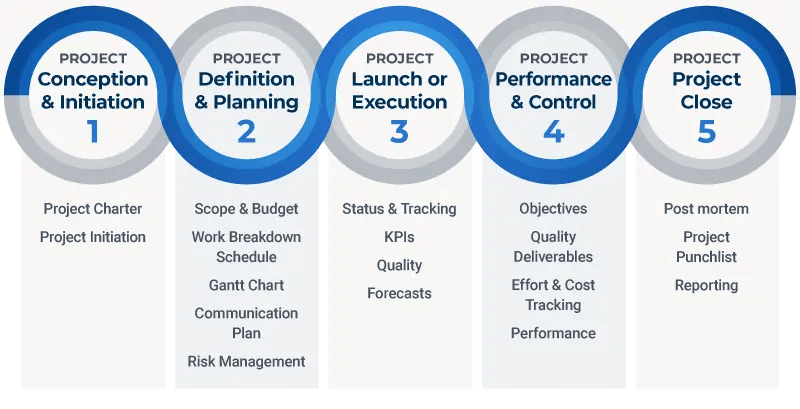
After broadly defining the goals of the project, teams begin project planning. This involves defining scope, budget, timelines, work breakdown structures, and more. Then, they launch and execute the project, with regular monitoring, status tracking, and KPI measurement. Finally, they close the project with thorough reporting and analysis of the lessons learned.
Check out this deep dive into each of the five phases of project management, as well as this guide to the project lifecycle.
Project Management Best Practices
Project management best practices include setting clear goals, creating a detailed project plan, identifying risks early, managing changes effectively, and communicating consistently with stakeholders. These practices help project managers keep projects within scope, on schedule, and aligned with business objectives.
Here are some best practices for project managers:
- Clear Objectives: Project managers should always prioritize knowing their project scope and goals before work begins. “I would be very hesitant to take on a project that does not have a clear objective, success criteria, scope boundaries, and well-understood assumptions and constraints,” Senapathy says. “If the key stakeholders and decision-makers are not known upfront, you are often setting the project up for false starts, confusion, and rework.”
- Planning Before Execution: Thorough planning clarifies scope and resource constraints, identifies risks, reveals dependencies, and prevents bottlenecks and miscommunication. “Everyone likes to say they want to ‘hit the ground running,’ but that can quickly turn into people tripping over one another if there is no alignment,” Senapathy warns. “Even in fast-moving or change-driven environments, planning must come before execution. Speed is valuable, but speed without coordination usually wastes both time and talent.”
- Clear Roles: Use a RACI matrix or similar model to clearly define roles and responsibilities so everyone knows who owns each task or section of the workflow. Revisit this model regularly and document any changes. “Projects suffer when people are unclear about responsibilities or begin stepping on each other’s toes,” Senapathy says. “Lack of role clarity is one of the easiest ways to create friction and slow a project down.”
- Open Communication: Maintaining openness and approachability fosters trust, encourages candid feedback, and boosts team morale by creating an inclusive environment rather than rigid authoritativeness. Being approachable, Water says, “allows people to share information with you that they wouldn’t normally share. This can be an advantage, especially when there are tight timelines, because then you would know of any risks or issues that might come up when working with other teams.
Maintaining open dialogue ensures that teams spot issues early and that people feel comfortable sharing concerns. “Identify all possible risks,” Water says, “but also plan for the unexpected. Allow people to be people and plan around their needs.”
— Erika Water, former project manager at Google and Microsoft
- Change Management: Good change management practices can make transitions smoother, enable healthy adoption of new tools or processes, and minimize disruption. “Change is necessary and healthy because it reflects learning, new priorities, or improved direction. The problem is unmanaged change,” Senapathy says. “Project managers need a flexible but structured approach to handling changes, whether large or small. It does not have to be bureaucratic, but it does need to be documented, understood, and applied consistently to prevent scope creep and misalignment.”
Essential Project Management Tools
Essential project management tools include project timelines, task lists, Gantt charts, and risk registers. In addition, tracking tools like Kanban and sprint boards help teams visualize workflows. Together, these tools help project managers organize work, schedule tasks, track progress, manage resources, and improve communication.
Here are a few key project management tools:
- Timeline: A simple chart showing project phases, milestones, and durations can provide key stakeholder information at a high level. The timeline can focus on key dates without task-level dependencies to give a general overview of progress.
- Task Lists: A structured list of tasks with owners, due dates, priority levels, and statuses can help project managers track progress and support delegation.
- Gantt Chart: This is a bar chart that illustrates a project schedule, with tasks shown on the vertical axis and time intervals on the horizontal axis. Bar lengths indicate task durations, while arrows indicate dependencies. This tool helps teams visualize the full project timeline, sequence work, and track progress.
- Kanban Board: This workflow board visualizes tasks as cards moving through status columns, such as “Not Started,” “In Progress,” and “Done.” It helps teams identify and limit bottlenecks.
- Sprint Board: A sprint board is used in Agile projects to organize tasks into columns during time-boxed sprints. It helps teams collaborate and manage iterative deliveries.
- Risk Register: Risk registers are spreadsheets or tables where users log potential risks, along with their likelihood, impact, owners, and mitigation plans. They allow managers to handle issues proactively to protect timelines and other resource constraints.
Check out this in-depth guide to project management tools to get started. Then, compare the best enterprise project management software and the best PPM software to pick the right one for your organization.
Choosing Project Management Software
To choose project management software, start by defining your goals and identifying the problems the software should solve. Then compare options using an evaluation framework, test real-world use cases, gather team feedback, and review detailed vendor information before making a decision.
Check out this guide to project management software, including how it works and how it can help your organization. Then learn how to choose the best project management software for your project.
The Future of AI and Project Management
AI is expected to transform project management, and it has already begun to do so. Autonomous agents can handle scheduling and risks. Predictive analytics help to optimize resources. This collaboration helps project managers shift their role to oversight, strategy, and ethical considerations.
McKinsey & Company’s 2025 global report, “The State of AI,” surveyed almost 2,000 business leaders worldwide. It found that about 88 percent of them used AI in at least one business function, up from 78 percent the year before, but only about one-third had scaled beyond pilot programs.
Still, AI is expected to be a new frontier. Sixty-two percent of respondents were experimenting with AI agents for autonomous tasks, with high performers redesigning workflows around them. This indicates the potential for increased multi-function deployment in coming years.
“AI will change project management significantly, but I do not believe it will eliminate project managers. It will make them far more productive,” says Yad Senapthy.
“Project managers will increasingly work alongside AI tools and agents that can take over much of the repetitive administrative work, such as status aggregation, schedule updates, meeting summaries, early risk identification, and draft reporting.
The bottom line is that project managers must learn how to work alongside AI, not compete with it. AI is no longer an edge case in project management. Leading software providers, training organizations, and certification bodies are already exploring how it can improve planning, execution, reporting, and decision support.
My view is that projects will benefit from fewer clerical errors, more time for human judgment and creativity, and lower execution costs as AI and automation continue to improve. Over time, this could elevate the role of the project manager and make project management even more impactful across industries.”
— Yad Senapthy, Founder and CEO of the Project Management Training Institute
TL;DR → Will AI replace project managers? No, it will make them far more productive.
Learn more about the role of AI in project management, and explore the future of project management.